Cleethorpes to Snaith

As you may have read, I recently ‘transited’ through Brigg on a journey from Cleethorpes to Snaith. None of the trio of locations are outwardly related, nor are there any obvious reasons to travel between any of them. That said, all reside within the LEYTR’s area of coverage. For reasons that will become clear within the LEYTR’s pages over the remainder of the year, Snaith in particular was worthy of a visit - and what better way to reach one of the most westerly settlements in the East Riding of Yorkshire than from one of the most easterly in Lincolnshire than by public transport?
For added effect - should that be hassle? - I chose to undertake this journey in the middle of the hottest May on record. But a hotel in Hull had been booked and, since the £60 fee was non-refundable, I was going!!
With Tuesday 26 May 2026 falling within the school holidays - on what used to be termed ‘Whit Week’ - and the day after the second bank holiday in just over a month, I would make use of school holiday timetables, although not until the following day, when my itinerary took me to Bempton, Bridlington, Flamborough, Hornsea and Hull.
I walked from my parents’ house in Cleethorpes to the town’s terminal railway station. What a day it was: perfect for a trip to the coast. I was travelling against the natural flow, which suited me perfectly, as things were less likely to become fraught with capacity constraints. I boarded Northern’s solitary journey from Cleethorpes at 1320 to Sheffield. The train had arrived at 1142 and the Sheffield-based crew worked it back from whence they came. The last time I caught this service from Cleethorpes, it operated only on Saturdays and was formed of a Class 144 Pacer. Now, with 150277 at Platform 3, the traction had grown slightly younger and more comfortable.
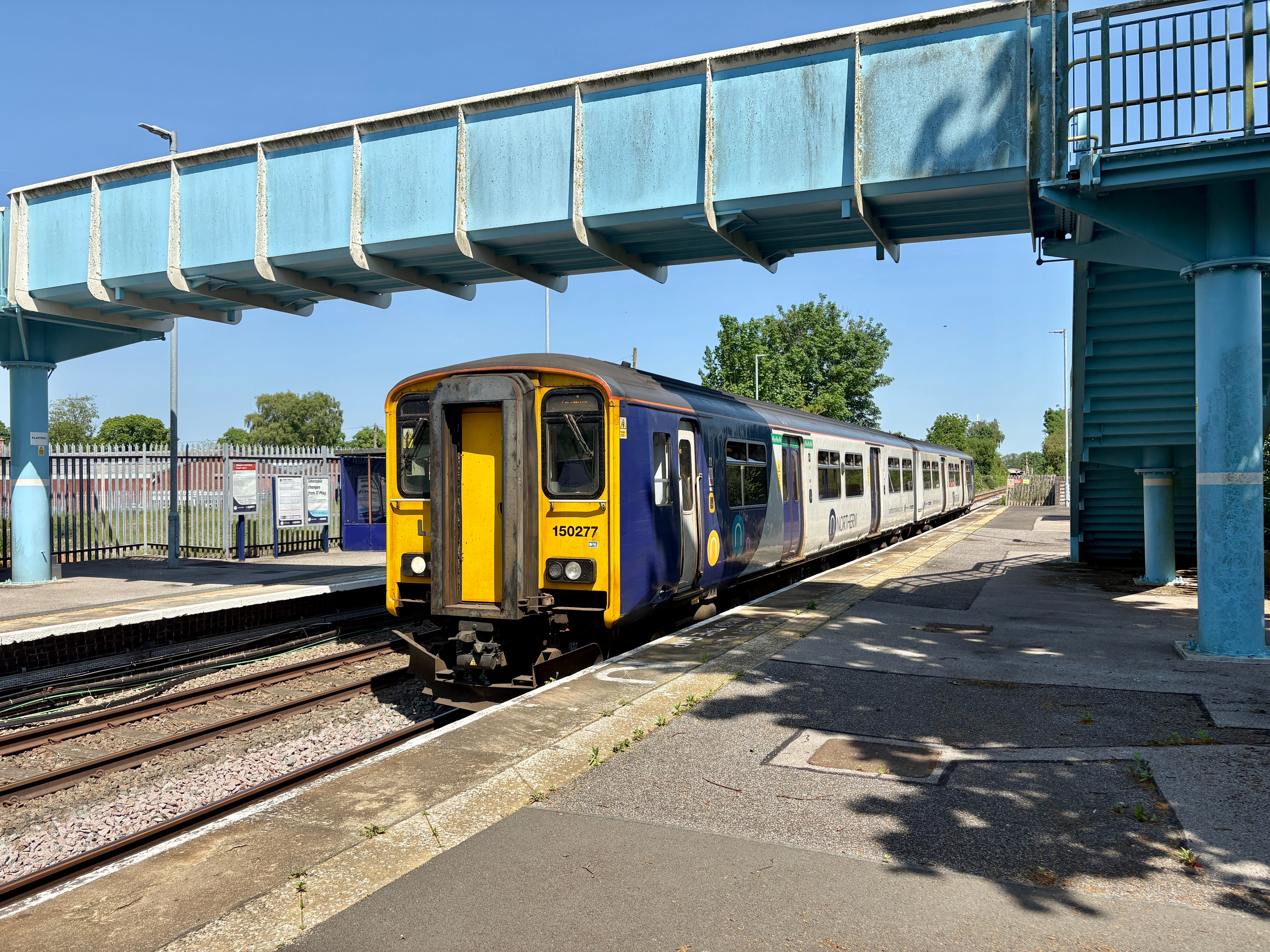
The constraints of the single-line section of track between Grimsby Town and Cleethorpes soon played out in front of me. A the arrival of a late-running TPE was being awaited by the 1313 EMR train to Barton-on-Humber, which didn’t leave until 1317 - one minute after the TPE turned up. We followed the train out on time at 1320, and yet, despite neither we nor the EMR Barton train stopping at New Clee, we were still held outside Grimsby Town for the Barton train to clear the station. We then sat just after Great Coates for three minutes, and between there and Healing we were delayed a further seven. This was down to a combination of long block sections and the Barton train having to terminate at Ulceby due to a signalling issue beyond.
Curiously, the Northern service doesn’t stop at Habrough. We did, however, call at Barnetby and I alighted at Brigg fourteen minutes adrift at 1406. Happily, my Hornsbys bus didn’t depart until 1440, so I had plenty of time to meander into the town centre via the former timing point of the Stagecoach Express 909.
NH18 BUS, an ex-Nottingham City Enviro200MMC saloon, arrived on the through Kirmington–Scunthorpe Service 4 at 1435, behind similar YX69 NPJ - though wearing its former operator’s base livery still - which was working a Scunthorpe–Kirmington journey. The 4 runs hourly between Scunthorpe and Brigg, whereupon the route bifurcates on alternate hours: one spur heading to Kirmington via Wrawby, Melton Ross and Humberside Airport, the other running the two-hourly Service 94 to Kirton Lindsey via Scawby, Sturton, Hibaldstow and Redbourne. What I found particularly strange was that for a small, family firm which prides itself on its impeccable credentials, the interior of NH18 BUS was still adorned not only with Nottingham City Transport logos but also NCT adverts and the NCT website. How very strange.
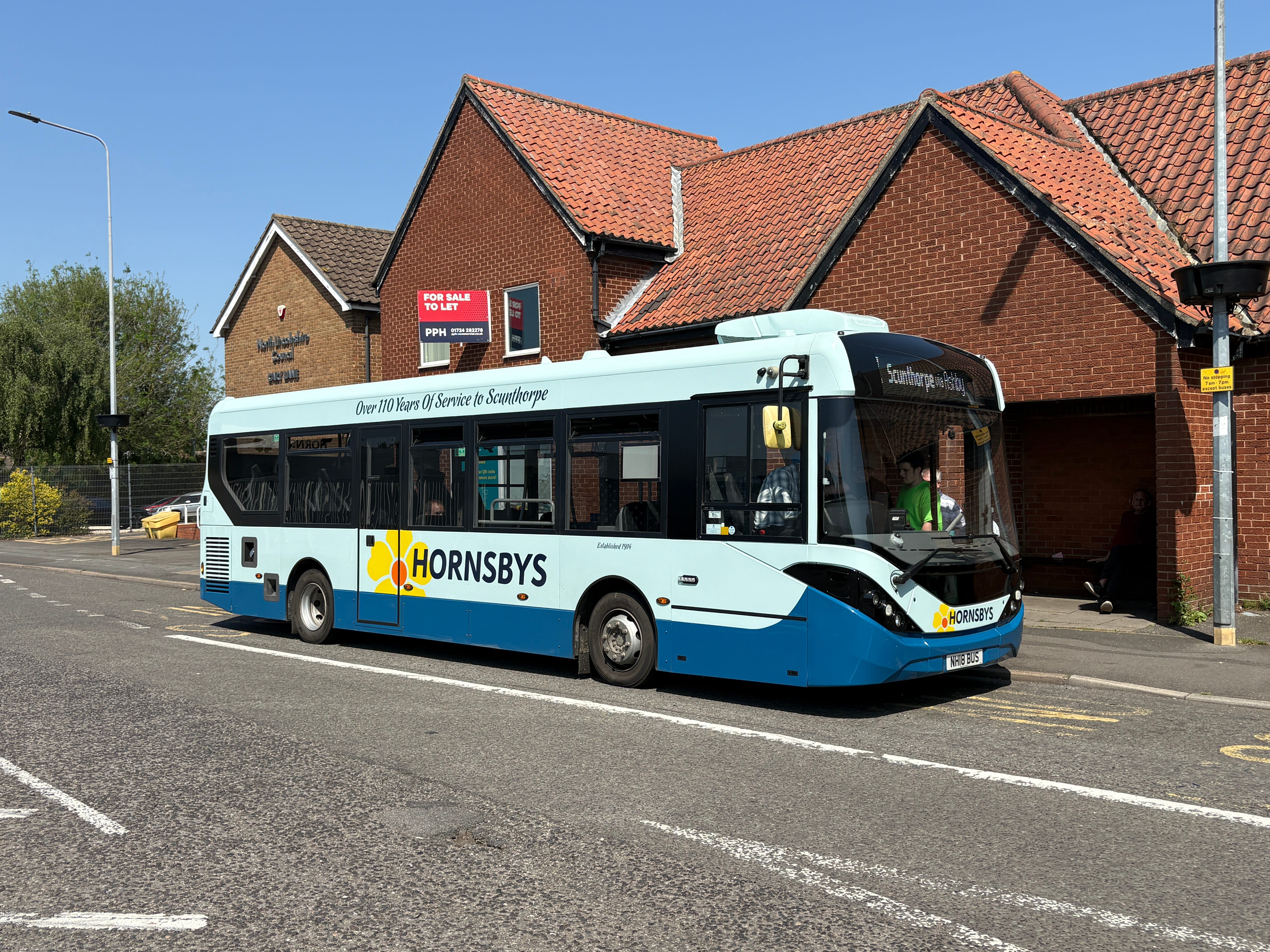
I’d never travelled on Hornsbys’ 4 before, nor had I ever been through Broughton. The bus took in some particularly narrow roads in the village, which the driver negotiated admirably. We descended Mortal Ash Hill towards Scunthorpe and then bore left to serve the GCT Bus Stop at Lakeside. Since my last visit, significant housing development has sprung up south of the retail park, which the 4 serves by meandering its way to Ashby High Street before heading north along Ashby Road and over the railway line into the town centre. We headed down Mary Street to the bus station and all alighted at the drop-off stop.
Cor, it was hot! I went in search of shade. The Parishes shopping centre, while not equipped with air-conditioning as such, offered solace - as did a trip to Greggs for a cold drink. I also undertook the time-honoured tradition of photographing buses in the layover area while awaiting my next departure.
That was the 1610 Service 360 to Goole formed of ADL Trident/ADL Enviro400, 19578 (AE10 BWL). Stagecoach was successful in being awarded this North Lincolnshire tender from 2 September 2024; previously, from 1 September 2019, the route had been operated by East Yorkshire. There is also a 361 variant, whose journeys are actually more numerous, and since the operator change there are additional journeys as a result of Stagecoach running the 360/361 from the Scunthorpe end, whereas East Yorkshire had run it from the Goole end.
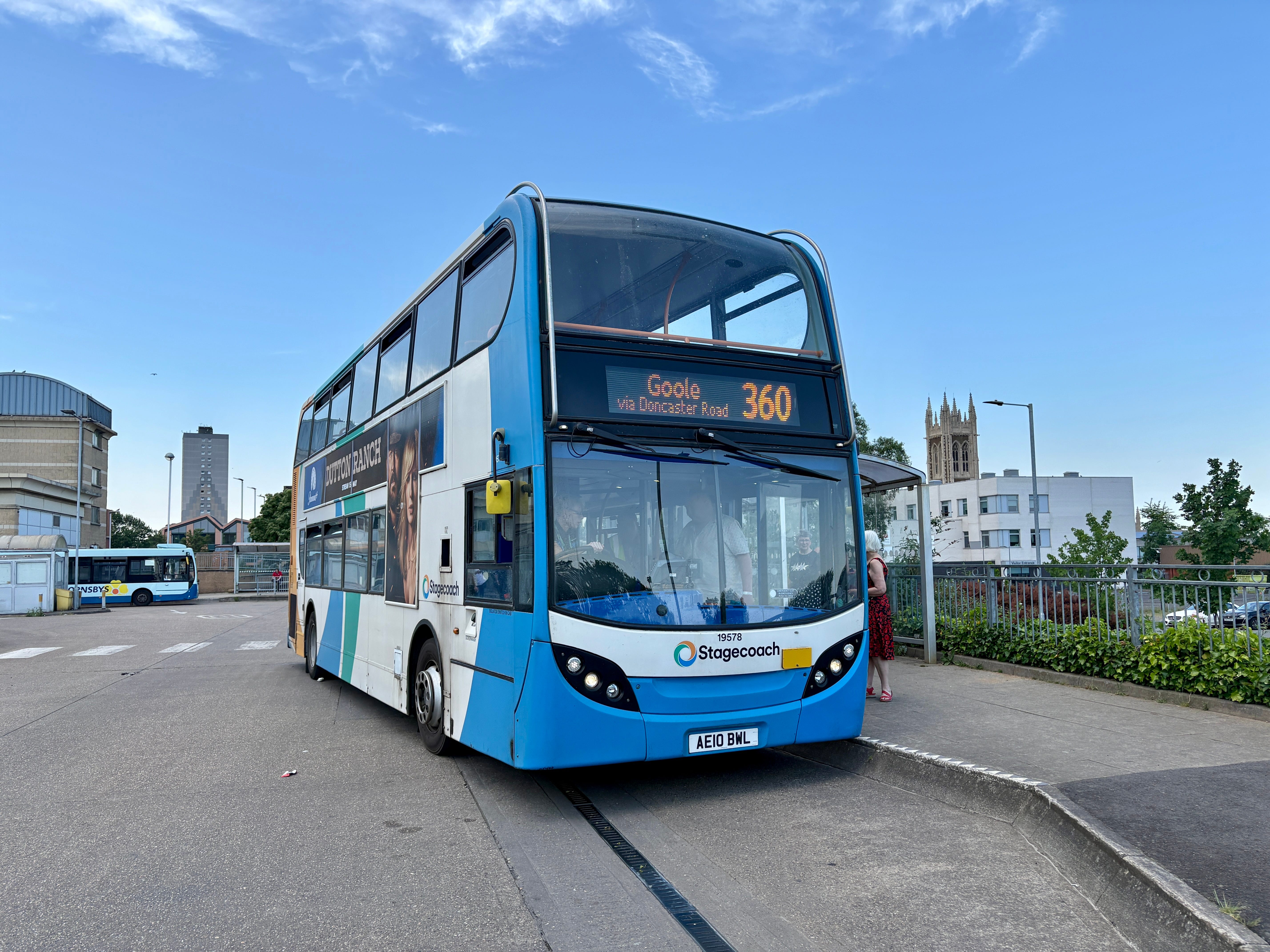
The 360 leaves Scunthorpe directly via Doncaster Road, while most journeys on the 361 initially head south to serve the Hospital before joining Doncaster Road via Church Lane and Kingsway. Both variants divert to serve the Tesco store. The routes diverge on the western bank of the Trent, after passing through Gunness and over Keadby Bridge. The 361 continues along the A18, turning off to serve Ealand and Crowle, then follows the A161 northwards, turning right in Eastcroft to serve The Riddings. The 360, by contrast, turns right in Althorpe and runs north along the Trent on winding, narrow roads through Keadby and Amcotts along the B1192, before heading inland along Meredyke Road to Luddington — where the 361 rejoins the route from the south. I think the 360 afforded the better, more scenic ride, certainly from the top of a double-decker!
Turning right off Luddington High Street, the 360/361 travel through Garthorpe, Fockerby and Adlington. The road bends left at Black Sands - the closest you’ll get to the confluence of the Trent and Ouse, where they meet to form the Humber, by bus - before serving Ousefleet, Whitgift and Reedness along the main road. The final settlement before journey’s end is Swinefleet, where the 360/361 pass Sweyne’s depot. Our trainee driver almost took a wrong turn in the centre of the village, necessitating a brief reverse before turning left along Church Lane to join the A161 into Goole. On the approach, we were held for just over fifteen minutes in Old Goole on Swinefleet Road while two vessels were welcomed into Goole Docks — an arrival which necessitated the opening of the second bridge on the aptly named Bridge Street.
Once in central Goole, we headed along Stanhope Street and then turned right into North Street. I suspect we ought to have completed a loop of the town centre, as we stopped opposite the row of bus stops used for town centre departures, and being late, some passengers who had been waiting there hurriedly crossed the road to board. The driver and her mentor welcomed them on, and the bus headed off - I don’t recall seeing it return. By then, I had sought sanctuary in Farm Foods, which had inveigled me through its doors with the lure of lower temperatures.
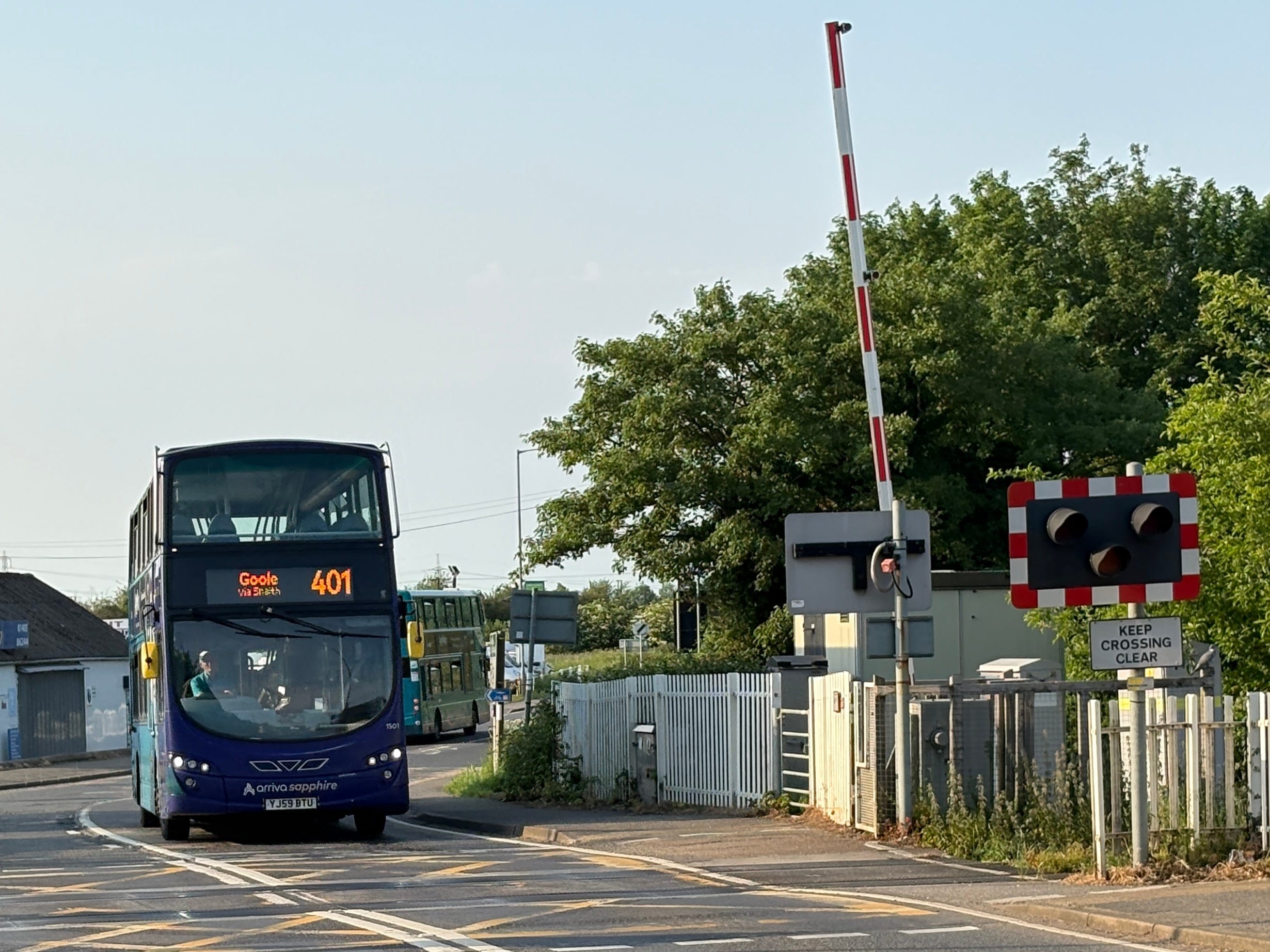
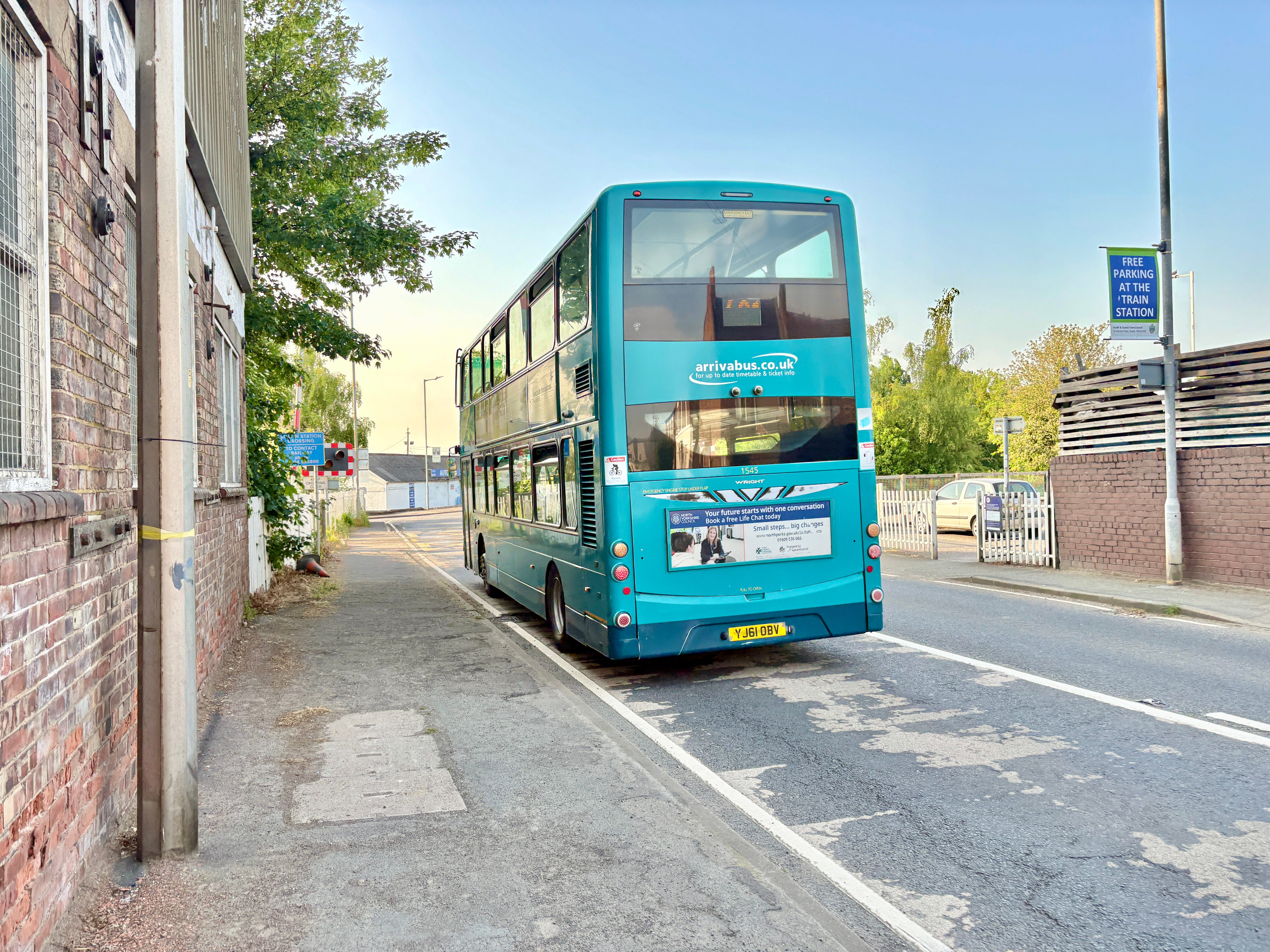
My final bus of the day was Arriva Yorkshire’s Service 401 to Pontefract. Normally running to an hourly headway, the final departure leaves thirty minutes earlier at 1805. I tracked its inbound journey and it undertook the loop via the railway station as expected. Of the trio of bus stops on North Street, the leading stop and its shelter contained no information whatsoever. The middle stop showed timetable details for the Goole Town Services only. The final stop showed timetable details for the 360/361 exclusively - except that the information was outdated by almost two years, still provided by East Yorkshire and making no mention of Arriva’s 401. I stood at that final stop, assuming it to be the ‘country’ stop, only for the bus, 1545 (YJ61 OBV), a VDL DB300 with Wright Eclipse Gemini body, to sail past me and pull up at the middle one. Oh well.
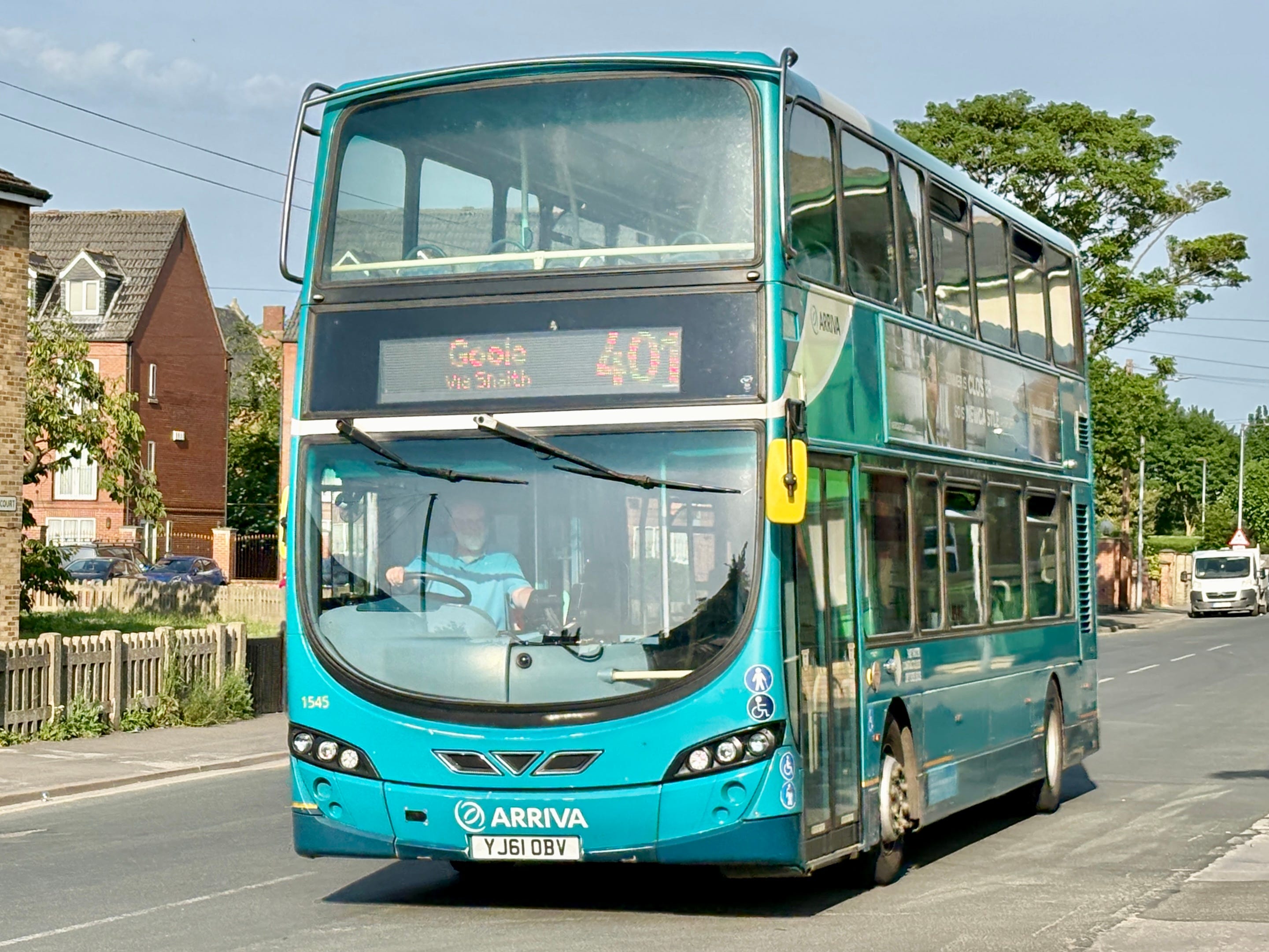
I paid my £3 to Snaith and, with just three of us on board, we left on time, spinning round the roundabout and heading back along North Street before turning left towards the railway station. With no trains due, we crossed the level crossing on Boothferry Road and headed out of town, passing the unusual sight of Morrison’s, whose store here shares its site with a sail-less windmill. We turned left onto the A614 out of town and over the M62, passing through Rawcliffe - a village I had hitherto never visited - and then East Cowick, before leaving the main road to serve West Cowick along Lodge Lane, High Street and Butt Lane. This brought us back out onto the main road, now in Snaith itself. The road meandered through the centre of the village and I alighted at the railway station stop.
The Lincolnshire & East Yorkshire Transport Review (established 1963) is one of the longest-running publications of its kind in the country. Published every other month, each full-colour, glossy edition offers a detailed overview of the local transport scene, combining the latest news with informed opinion.
We provide in-depth analysis of changes to local bus and rail services, a comprehensive fleet section reporting acquisitions and disposals by all local bus, coach and rail operators, and a range of historical and contemporary articles exploring the rich tapestry of transport across our region.
An annual subscription costs just £15. We also offer a ‘try before you buy’ option—receive the latest edition by post to your home or office for just £3. There is a Rest of the Year option, charged pro rata.
For more information, visit: www.gct113.com/leytr