Lumo West Coast
My first journey with the UK’s newest open access train operating company, Lumo West Coast

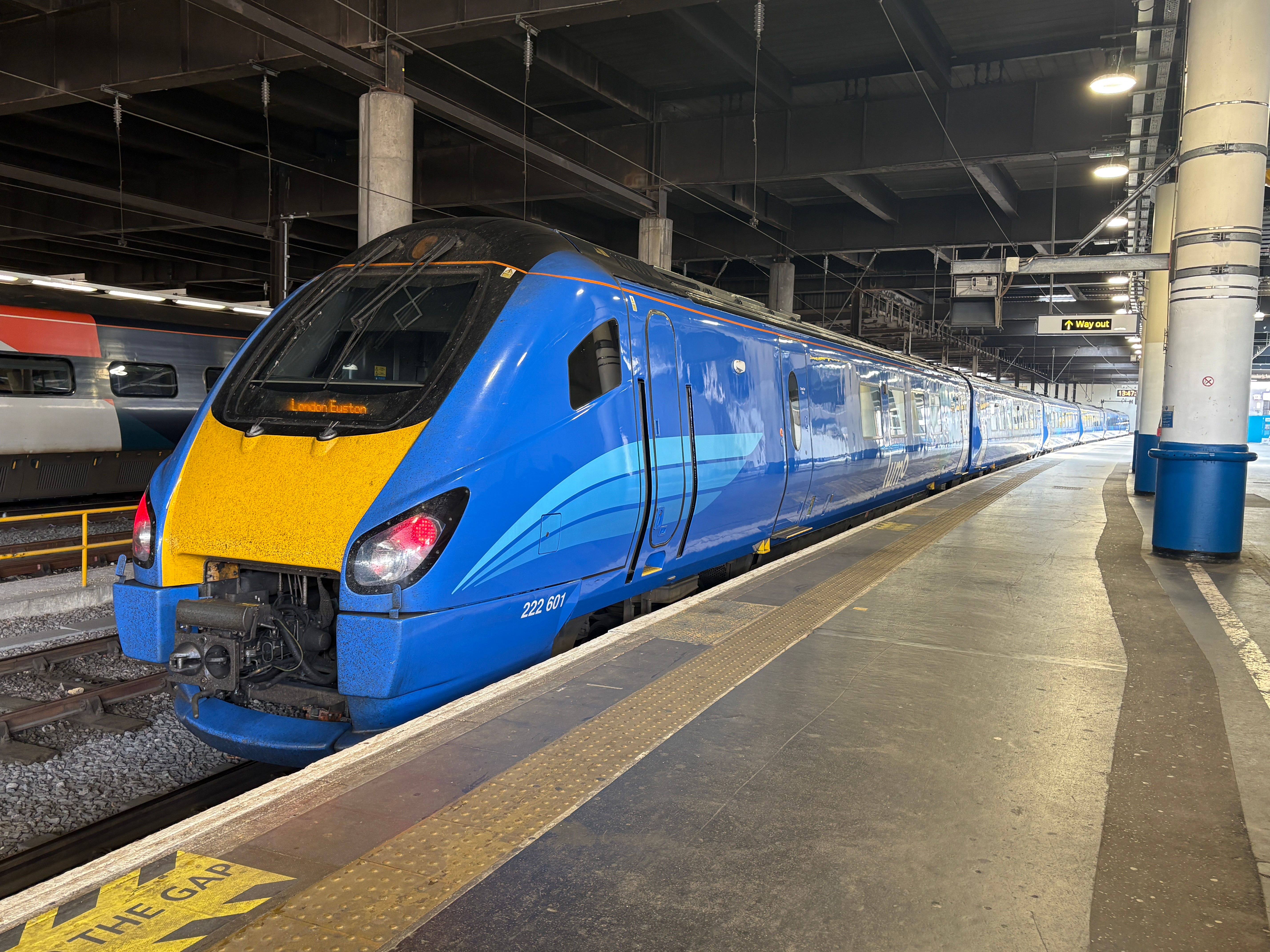
Our Lumo West Coast train was due to depart London Euston at 1418 on Sunday 2 August 2026 and although the platform had yet to be announced, Realtime Trains correctly predicted Platform 16. As we descended the ramp at around 1345, there stood 222601 – formerly EMR 222101 – having arrived from Preston at 1328. It had departed Preston, Lumo West Coast’s HQ, at 1040. There are between three and four end-to-end journeys on Mondays to Saturdays with an additional ‘short’ between Preston and London. On Sundays there are three end-to-end journeys and one Preston–London ‘short’ in each direction. Four of the 5 ‘222s’ are needed each day, with one of the 6-car sets spare. While this level of spare capacity is commonplace – indeed, deemed excessive – in the bus industry, it is notably ‘tight’ in rail operations. But, Lumo must consider it acceptable enough to provide its service in full.
Externally, the train looked resplendent in Lumo’s striking blue livery, which somehow reminded me of the original Gibraltar Bus Company colour scheme carried by its small fleet of TransBus Darts in 2004. Underneath the fresh paintwork, however, there was little disguising the Meridian’s East Midlands Railway origins. Cosmetic improvements had been kept to a minimum and, for all the marketing, it was still recognisably the same train. The new Class 222/6 designation reflects the substantial modifications carried out for Lumo service, including the six-car formation (vice 5 or 7 with EMR), revised wholly single-class interior, technical alterations and the addition of bodyside cameras to assist the driver in observing the train-platform interface. Rather than Guards, Lumo employs ‘Ambassadors’. I still find the title rather cringeworthy. Likewise, its drivers are now branded ‘Customer Drivers’, reflecting the fact they make the routine announcements regarding delays and the imminent closure of the doors.
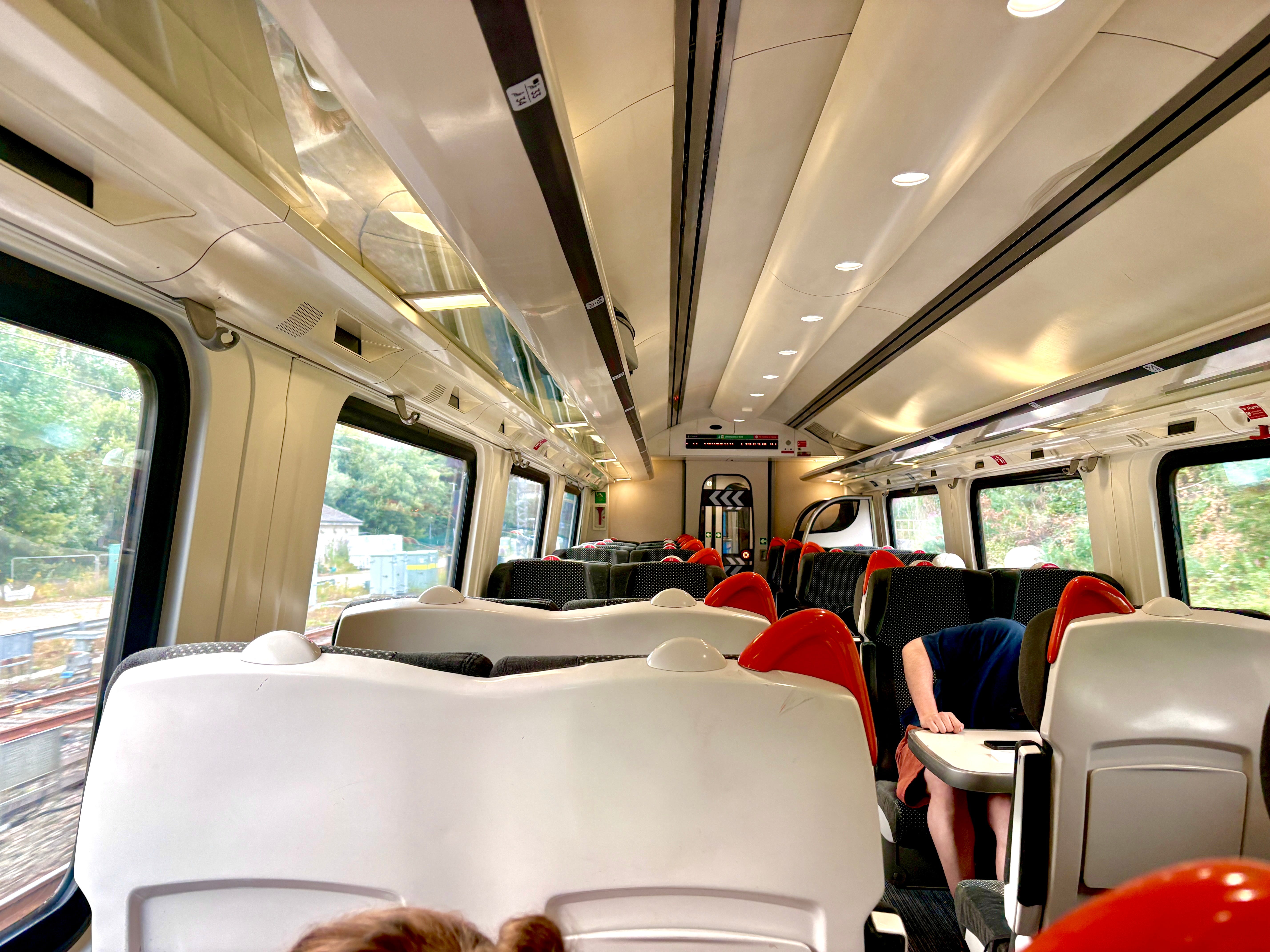
Our driver arrived at about 1355 and, precisely on cue, released the doors at 1400. We were booked in Coach C and, with only a handful of passengers waiting on the platform, boarding was pleasantly relaxed. The suitcase was quickly stowed and, perhaps most pleasingly, the air-conditioning was performing exactly as it should. During the fleet’s EMR career this could be decidedly hit and miss, so despite relatively modest cosmetic changes to the interior, the temperature throughout our four-hour journey north proved consistently comfortable.
Lumo’s electronic seat reservation system appeared not to be functioning. Fortunately, we had boarded at the originating station and therefore had our pick of the available seats. Despite specifically requesting a table, we had been allocated a bank of three airline-style seats. I assumed every table had already been reserved by those booking further ahead than ourselves. As departure approached, that theory was emphatically confirmed. The platform suddenly filled with hundreds of passengers and within minutes the train was exceptionally busy, leaving London with a substantial number of standees. Many of those travelling left at Milton Keynes, apparently heading for a nearby festival, and the train was noticeably quieter thereafter.
One of the three Ambassadors made several announcements concerning ticket validity. Perhaps the clearest indication that the role carries none of the operational responsibility traditionally associated with a Guard was the uncertain manner in which they were delivered. They included incorrect operator names, muddled initials and a generally hesitant presentation. This particular member of staff simply lacked the authority that naturally comes from having direct responsibility for the train’s safe dispatch and operation.
That said, all three Ambassadors were courteous, approachable and regularly visible throughout the journey. A Scottish lady checked our tickets within the first 20 minutes of our punctual departure from Euston. The trolley service remained static for much of the southern section, almost certainly because of the volume of passengers and crowded vestibules. After Milton Keynes everyone had found a seat and we continued north, calling at Nuneaton and Crewe whilst maintaining time throughout.
A crew change took place at Preston, after which a distinctly Scottish voice announced the imminent departure. Lumo West Coast crews are based at London Euston, Preston and Stirling and the second crew seemed noticeably more natural behind the public address microphone, although their announcements were considerably quieter than those made earlier in the journey. Shortly after leaving Preston, the trolley began making its way through the train, suggesting the static catering service south of Preston had indeed been a pragmatic response to the heavy loading rather than a planned restriction.
It is fair to say that Lumo is working these Meridians considerably harder than East Midlands Railway ever did. Daily mileages are substantially greater, although the longer non-stop sections between stations may ultimately prove less demanding mechanically than the repeated acceleration and braking of their former inter-urban duties. Lumo’s West Coast operation currently comprises five refurbished six-car Class 222/6 Meridians, numbered 222601-605 and converted from former EMR units 222101-105. The refurbishment was undertaken by Alstom at Widnes on behalf of Beacon Rail and incorporated intelligent engine management software intended to reduce fuel consumption.
The Meridians are, however, only a stop-gap solution. Lumo’s long-term intention is to replace the diesel fleet with five new electric trains, currently designated Class 820, once manufacturing capacity becomes available. They are expected to enter service during 2028 and will allow diesel operation to cease on a route which is almost entirely electrified. Until then, these former East Midlands Railway workhorses have found an unexpected second career linking London Euston, Preston and Stirling at a time when many believed their future lay much closer to home.
One final thing to note is connectivity. Lumo’s own Wi-Fi was incredibly easy to connect to but offered very slow speeds. Your own mobile data, my own choice usually, continues to be hindered by whatever the coating is that the trains have on the exterior of their windows. This has been a feature of this train and its sister Class 220/221s from new, with very poor connections. I understand that train crew have historically had to use the rear driving cab in order to make phone calls. For passengers, notably better connection can be found in the vestibules, where there is an absence of coated windows.
Seen above is 222601 departing Carlisle bang on time at 1819, bound for Stirling.
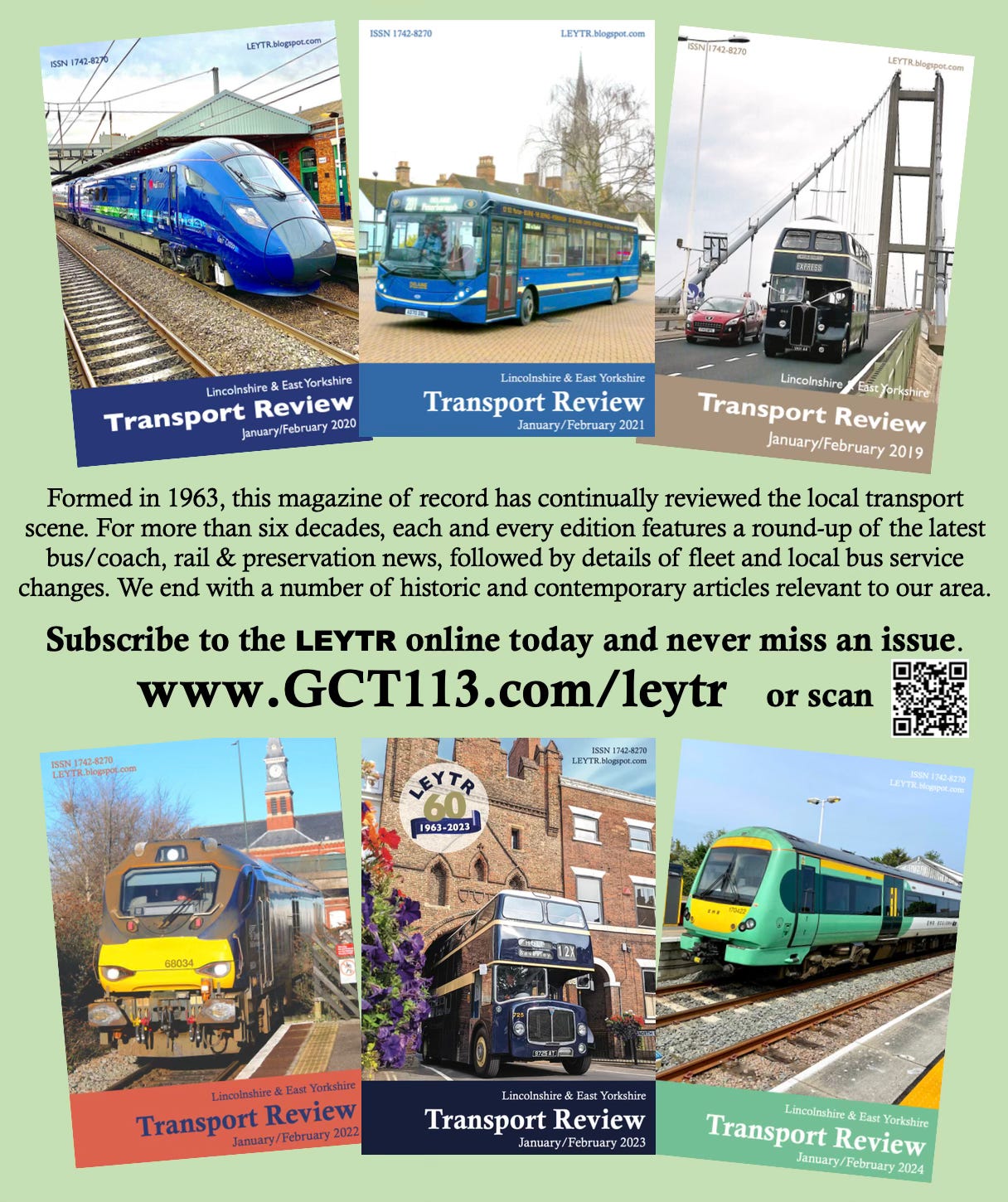
The Lincolnshire & East Yorkshire Transport Review (established 1963) is one of the longest-running publications of its kind in the country. Published every other month, each full-colour, glossy edition offers a detailed overview of the local transport scene, combining the latest news with informed opinion.
We provide in-depth analysis of changes to local bus and rail services, a comprehensive fleet section reporting acquisitions and disposals by all local bus, coach and rail operators, and a range of historical and contemporary articles exploring the rich tapestry of transport across our region.
An annual subscription costs just £15. We also offer a ‘try before you buy’ option—receive the latest edition by post to your home or office for just £3. There is a Rest of the Year option, charged pro rata.
For more information, visit: www.LEYTR.com