Sanctuary Buses??
Society has plumbed to such depths that local buses are now being designated ‘safe spaces’ for vulnerable women.

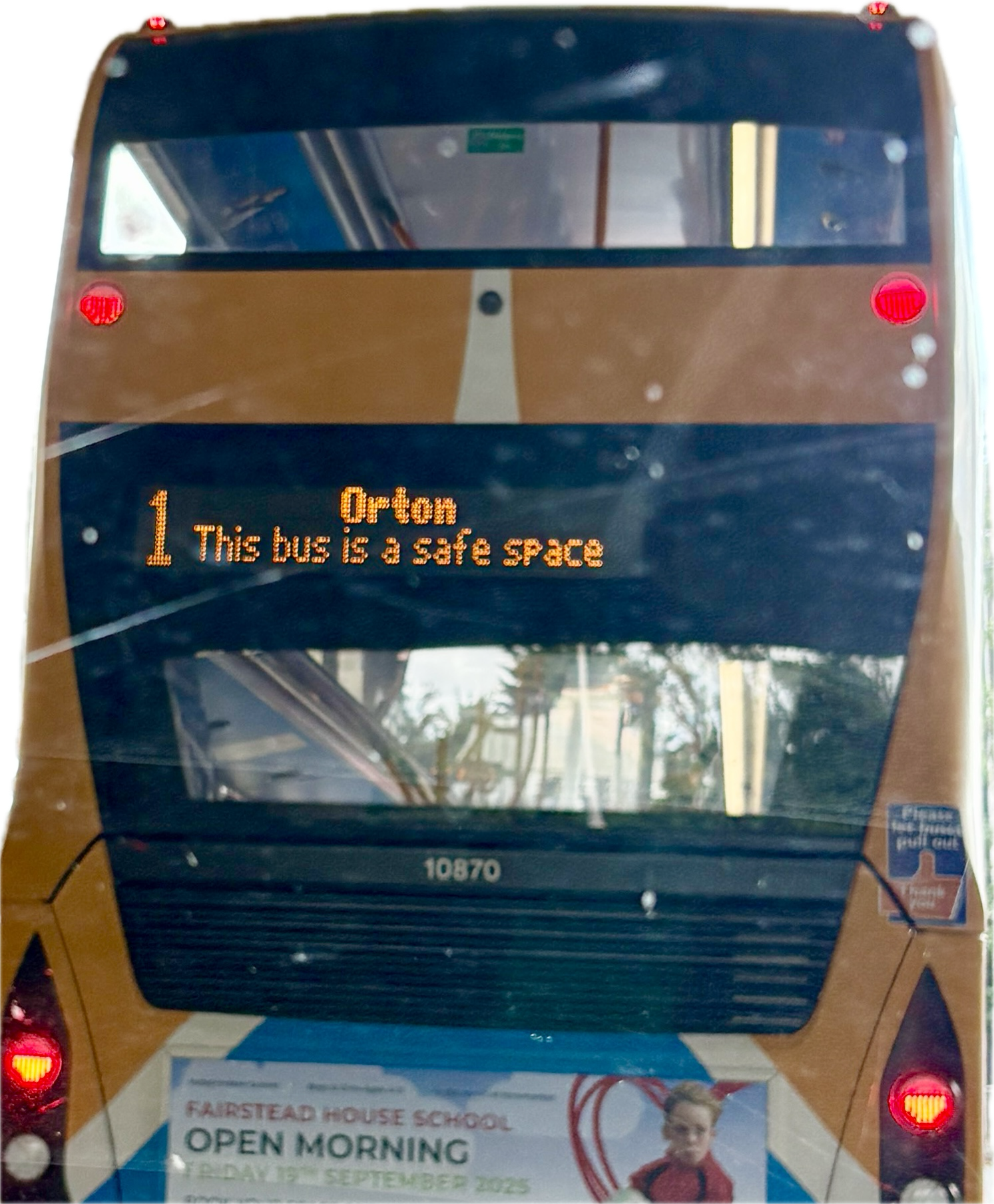
Stagecoach East has been praised for its decision to designate buses across Cambridgeshire, Peterborough and Bedfordshire as “safe spaces” for women and girls at risk of violence or abuse. Stickers have been placed on vehicles, drivers trained, police briefed and rape crisis groups consulted. The initiative is part of the Businesses Against Abuse programme. There is no doubt that some women have already been spared potential harm as a direct result. Drivers have diverted buses to get vulnerable passengers to safety. One predator has been arrested following intervention. For those involved, these are tangible successes and should not be dismissed.
Yet beneath the applause lies a reality that ought to trouble us all: the very notion that a bus – a public service vehicle, designed to move people from A to B – must now double as a refuge from male violence. It is an indictment of society that ordinary, essential transport has to be recast as sanctuary because the streets outside cannot be relied upon to be safe.
The abuse faced by women and girls is not an abstract concept. It is daily, grinding, corrosive reality. The testimonies quoted at the launch of the scheme were blunt. One young woman admitted she does not walk at night in her neighbourhood because it simply is not safe. Another described being followed onto a bus, only feeling secure once her husband collected her. Maria, another passenger, summed it up with chilling brevity: “Walking isn’t safe.”
In this context, buses have become more than vehicles. They are “mobile hotspots” equipped with twelve cameras each, driven by staff who have been trained to recognise predatory behaviour and authorised to intervene. The messaging is clear: if you feel unsafe, flag down a bus and you will be taken to safety.
I do not criticise Stagecoach East for stepping into this arena. Indeed, the company has behaved responsibly. Managing Director Darren Roe is entitled to be proud of his staff. Training teams and frontline drivers alike have shouldered a role they could never have imagined when they joined the industry: custodians of public safety in the most fundamental sense. To those drivers who have already stopped predators in their tracks, diverted journeys or offered reassurance to terrified passengers, credit is due.
But we must pause and ask: why is this necessary? Why should a bus driver – whose first duty is to operate a vehicle safely, keep to time and collect fares – be pressed into service as protector against harassment and violence? Why is a commercial transport operator being compelled, in practice if not by law, to plug the gaping holes left by a society unable or unwilling to protect women on its streets?
That this scheme is needed says less about the ingenuity of Stagecoach than it does about the failures elsewhere. Policing resources are stretched thin, but it is not credible to suggest that the answer lies in outsourcing the job of safeguarding women to bus companies. Authorities have failed when the instinctive advice to a woman being followed is not “call the police” but “flag down the number 5 to St Neots.”
Some will argue that public transport has always doubled as an informal safe space. The late-night bus home from town, the first bus out at dawn for shift workers, the driver’s familiar face on a rural route – all can provide comfort. That is true. Yet turning this natural reassurance into formal policy risks normalising the idea that streets are unsafe by default and that safety can only be found on board a branded vehicle under CCTV.
Nor should we underestimate the additional burden placed upon drivers. Already they contend with abuse from passengers, road congestion, ticketing disputes and the constant pressure of punctuality. Now they are told they may be called upon to confront predators, de-escalate volatile situations and assume responsibility for traumatised victims until police arrive. Some will handle it with aplomb. Others will find the pressure intolerable. It is unfair to place them in such a position.
There is also the practical question: what happens when the driver is alone with a vulnerable passenger late at night? What safeguards exist to ensure that trust is not misplaced? Training and cameras mitigate risk, but we must not ignore the complexities introduced by designating a moving vehicle as sanctuary.
Still, it would be callous to dismiss the scheme outright. For the women already helped, this is not a theoretical debate. It has been the difference between continued harassment and rescue. Campaigners such as Norah Al-Ani of Cambridge Rape Crisis Centre are right to welcome “a brilliant first step.” The phrase “first step” is crucial. A bus as a safe space must be seen as an emergency stopgap, not the end goal.
The real solution lies elsewhere: cultural change that calls out abusive behaviour before it escalates; robust policing that treats harassment as crime rather than nuisance; education that teaches boys respect rather than entitlement; urban planning that prioritises safe, lit, walkable streets. When those foundations are in place, buses will not need to be labelled as sanctuaries. They will simply be buses again.
Until then, Stagecoach East’s intervention will be both praised and lamented. Praised, because it has already saved women from predators. Lamented, because it represents how far we have fallen that the humble bus must shoulder such responsibility.
We must applaud the individual drivers who have gone above and beyond. We must support the campaigners who have turned despair into practical action. But we must also be clear-eyed: this is not how it should be. Public transport is vital infrastructure, not an auxiliary refuge service. A safe society should ensure that a young woman stepping off a bus does not need to cling to it for safety in the first place.
When we reach the point that a bus route is once again just a bus route, and not a lifeline against male violence, we will have made genuine progress. Sadly, this appears a long way off. Promoting its buses as being ‘safe spaces’ should not be seen by Stagecoach East as badges of honour, but as stark reminders of collective failure.