The DRT Man Cometh
Applying vague time slots to public transport

I recently had to cancel an entire day of my life because Worcester Bosch, the manufacturer of my nearly-new gas boiler, would only offer me an 0700–1730 time slot for their plumber to visit and undertake what was, by all accounts, a straightforward warranty repair. At what point does a time ‘slot’ stop being such? This was a day slot within a week and frankly unacceptable. Even the less agreeable E.ON is willing to offer morning or afternoon slots for its visits, but not Worcester Bosch. Would its plumber really arrive at 0700? Well, nearly. ‘Simon’ came knocking at 0735. Perhaps I should be pleased that, despite this obvious lowering of acceptable booking procedure from the consumer’s perspective, matters have at least improved to the point where you might actually see a plumber before 0900. It has not always been thus. Flanders & Swann captured the problem perfectly in the 1960s with their song The Gas Man Cometh, written to illustrate just how frustrating it once was ‘getting a man in’ and dealing with the fallout thereafter.
It got me thinking about time slots more generally. There is no such equivalent with scheduled bus and rail services. A train either departs at 1500 or it does not. Increasingly, however, DRT – demand responsive transport – is seen as the order of the day and this does operate within slots. There are three distinct DRT schemes in the LEYTR area: the industry-leading CallConnect from Lincolnshire County Council, North East Lincolnshire’s Phone ‘n’ Ride and the more recent JustGo from North Lincolnshire Council. A more limited MiBus scheme is operated by East Riding of Yorkshire Council. The pages of the LEYTR have seen these differing DRT operations reviewed in some detail, though here I wanted to revisit my experience of the newest and most junior scheme.
In July 2024 I downloaded the JustGo app and booked an A to B journey within a time slot that suited me. The process was simple and since I booked it weeks beforehand I assumed that I had a reasonable chance of securing the time slot I needed. Earlier that day I had paid a fleeting visit to the volunteers at the Sandtoft Transport Centre and left copies of my book Grimsby-Cleethorpes Transport 1957-1993 for them to restock in their shop. I fancied making the entire journey home by public transport. The most obvious route involved a DRT trip to Crowle railway station followed by two trains – first to Doncaster and then to Peterborough – before a final bus journey.
Northern’s trains depart Crowle for Doncaster every two hours. The 1500 departure seemed appropriate and so I entered a 1430 departure time from Sandtoft into the app. The journey was only three miles and Google Maps suggested a driving time of nine minutes. Allowing half an hour seemed entirely reasonable. The fare was also reasonable at £2.50. The JustGo app approved my journey and took my fare. In the Driver Notes section I added that I wished to catch the 1500 train to Doncaster. I was all set.
On the day in question the JustGo app sent me a message advising that the bus would be 14 minutes late. This meant a revised pick-up time of 1444. That was not a problem since it still left around seven minutes to connect with my train at Crowle. Forty-five minutes before the amended pick-up time I received another notification informing me that the bus was now 18 minutes late. What was not made clear was whether this represented a further four minutes on top of the existing delay (making the pick-up 1448) or an entirely new delay of eighteen minutes (which would push the pick-up to 1502 and comfortably ruin my plans).
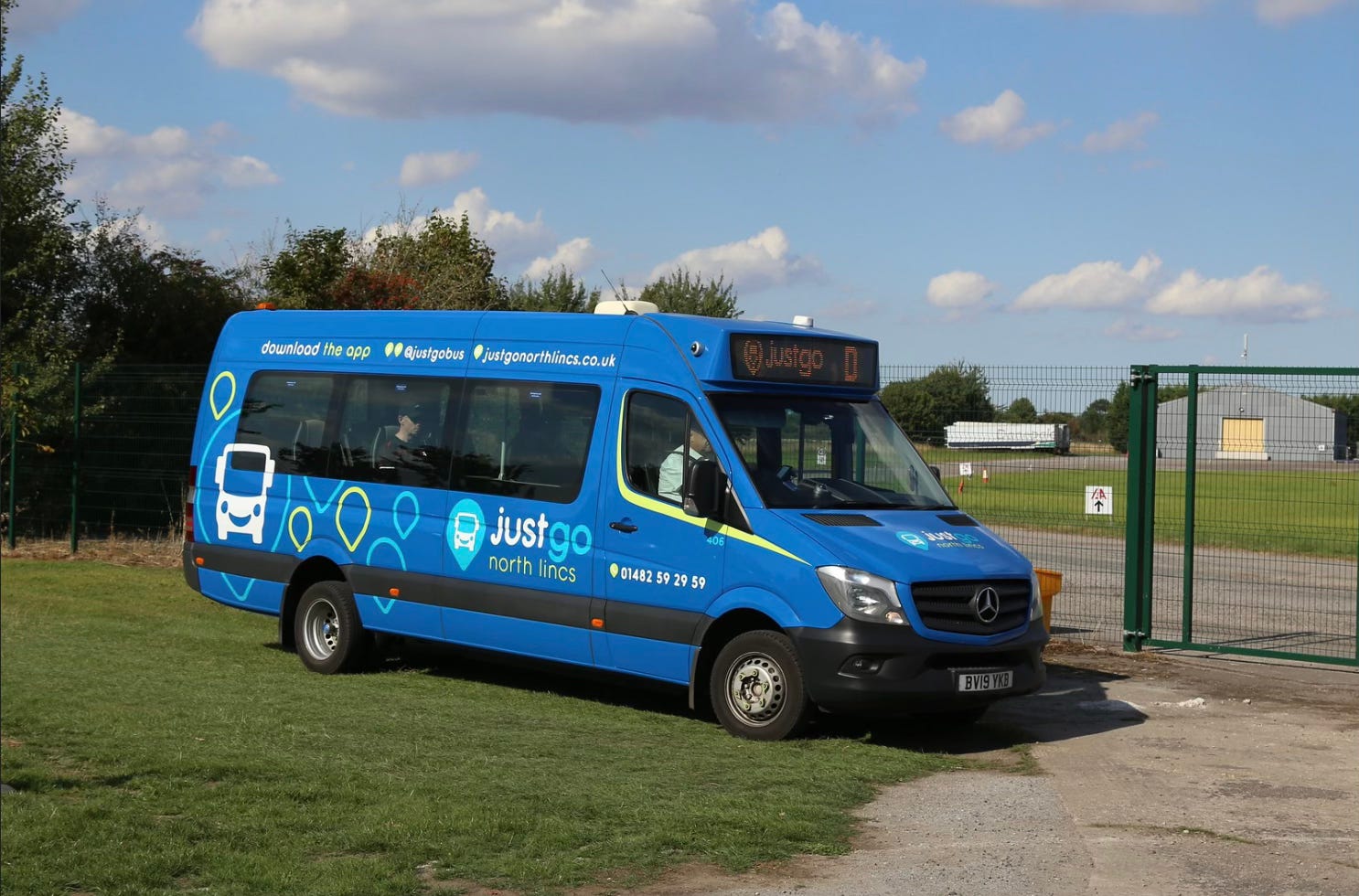
The Law of Sod ensured the latter almost came to pass and at 1459 one of the specially-branded blue Mercedes-Benz Sprinters finally appeared. Owned and operated by East Yorkshire Motor Services, vehicle 406 (BV19 YKB) was deployed on this occasion. My driver had not yet consulted his driver notes for this particular job and was therefore unaware that I had just missed my train. The next departure from Crowle was at 1700 and I had no desire to loiter at that isolated station for nearly two hours. I therefore asked if he could take me west instead to Thorne and drop me at Thorne North railway station, where I could intercept an hourly Hull–Doncaster train. Google Maps suggested this was a fourteen-minute journey. My driver agreed and we set off.
During the journey he explained that the JustGo operation is provided by East Yorkshire’s Elloughton depot. He had worked for the company for decades and previously drove National Express coaches. We soon discovered a number of mutual acquaintances in the industry and he mentioned that retirement was not far away, describing the JustGo work as something of a ‘grandfather rota’. It must be said that the pace of the work seemed fairly relaxed. He probably encounters about as many people during a shift as the average Worcester Bosch plumber.
However he also explained that he is strictly not permitted to leave the administrative boundary of North Lincolnshire. This restriction is in fact clearly stated on the JustGo website. And since Thorne lies in South Yorkshire, a gentleman’s agreement was therefore struck.
While I reached several other conclusions about the JustGo scheme in my original LEYTR article, the focus here is the concept of the time slot itself. Perhaps Worcester Bosch’s approach of effectively cancelling an entire day is the least-bad option. I could hardly complain that the plumber was late given such a generous window. By contrast I simply would not rely on JustGo, or any DRT service, if I needed to catch a specific train where missing it would seriously disrupt the remainder of the journey. How could I?
Fortunately the limitations of DRT time slots and the understandable reluctance of passengers to risk missed connections mean that such services are largely ignored for time-sensitive travel. Ironically we should probably be grateful that a day-long ‘slot’ of the sort issued by Worcester Bosch is not something offered by the bus or rail industries. Even a narrower slot, while appearing more passenger-friendly, still fails if the vehicle simply does not arrive within it.
Long live the scheduled passenger bus or rail service. We may shiver on a freezing platform awaiting a slightly delayed train, but at least we have not had to cancel our entire day for the privilege.